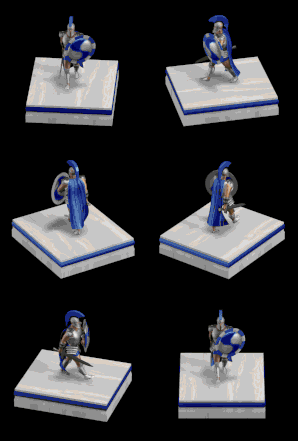
3D Studio & 3D Studio MAX: The Powerhouse of PC Gaming
It's no secret. If you've played any DOS or Windows games from the 'golden' era (1993 ~ 2003) the pre-rendered graphics have most likely been done with 3D Studio. And while yes, MAX was used to create realtime 3D models, its most famous and characteristic results came from the very smooth classic rendered scenes which didn't need to worry about polygons. I'm not certain why there's been contention and conflation with live 3D models and pre-rendered graphics (perhaps it's an education thing where we've come full circle and such things are not common knowledge anymore?), they're quite different. And not only that, game engines often have to cull polygons to save compute.
Two of my favourite quotes from Gary Yost explaining 3D Studio and MAX's release:
We came out with this version 1 of MAX which was really 0.7 or something-- blew the doors off SIGGRAPH. Microsoft had just bought Softimage, and they thought they were such hot sh*t, and then we showed Michael Girard and Susan Amkraut's bipedal animation thing, and all sorts of stuff. And we had these huge crowds... we had kept it a really good secret that what we were doing.
SIGGRAPH 1989, when Alias had found out about what we were doing on the PC with 3D Studio DOS, we showed the first DOS version in July of 1989. Alias issued a memo to all of their staff and sales reps, about how our little 'DOS toy' was no threat to Alias, and that they should not worry about it: because Autodesk is a nobody, and they're never going to get anywhere in the field of 3D, and you can just forget about these guys.
The fact that an affordable 3D modelling program was then available on the PC caused sales to shift in 3D Studio's favour. Development studios didn't need to purchase separate UNIX systems and could develop in a cheaper existing DOS/Windows ecosystem. I also think because they're testing the games on the PCs, it just made more sense to also have development tools on the same platform. Today of course everything is all about cross platform, but back then everyone used a PC for anything meaningful.
Accidental Hue Shifting
Because many of the games had to use 256 colours*, this resulted in unintentional hue shifting where the pre-rendered graphics associated the closest colour in the palette (or rather the algorithm used to convert it to the palette). Hue shifting happens to be very pleasant to the human eye from an artistic perspective, so while this was unintentional from early computer graphics, it added a missing piece to the puzzle of visual enjoyment that's harder to come across (unless someone does pixel art and manually implements hue shifting with a palette, but, that's not being applied to 3D graphics anymore).
* A two pronged casualty: commercial 2D accelerators couldn't handle 16-bit "high colour" until later, and when they could, 16-bit colour caused a huge performance hit-- especially going beyond 640x480. A generous 233 MHz Pentium 1 can still suffer slowdowns on some 16-bit games... two off the top of my head would be: Speedy Blupi and Tzar.

An apple from Drilling Billy exhibiting hue shifting, whereby the darker edges become brown instead of simply a darker green.
Games using 3D Studio Pre-renders
A quick list of games that I know used 3D Studio or 3D Studio MAX for their pre-rendered graphics. I placed an asterisk on the ones I'm fairly sure are correct, but could potentially be swapped if not.
| Games Built with 3D Studio (DOS) | Games Built with 3D Studio MAX (Windows) |
|---|---|
| Age of Empires 1 | Army Men |
| Dungeon Keeper 1 | Age of Empires 2 |
| Lords of the Realm 2 | Caesar 3* |
| Theme Hospital (cinematics) | Kohan: Immortal Sovereigns |
| Warcraft 2 (cinematics) | Diablo 2 |
| Seven Kingdoms 1 | NoX |
| Drilling Billy / Worlds of Billy* | Gruntz* |
| Dr. Lunatic Supreme with Cheese | Get Medieval* |
| Caesar 2 | Rage of Mages / Allods* |
| Gubble 1 | Tzar: Burden of the Crown |
| Stonekeep | Pharaoh |
| Humpty's Scramble* | Stronghold / Stronghold Crusader |
| Gubble 2* | |
| Heroes of Might and Magic 3 | |
| Mummy Maze (Popcap) | |
| Rollercoaster Tycoon | |
| Return of the Incredible Machine: Contraptions |
When Game Studios Don't Lose the 3DS Models
I had always thought that the reason why game studios remastering the artwork didn't do so because they lost the original 3D Studio assets (and for the most part, this is unfortunately true). However, in many instances where the original files are present, the new individuals heralding the development never bother to use them or consult with the original people and then just make completely new models (as in the case of Diablo 2), or, take the original models and 'overbake' them to the point where they've lost the original magic.
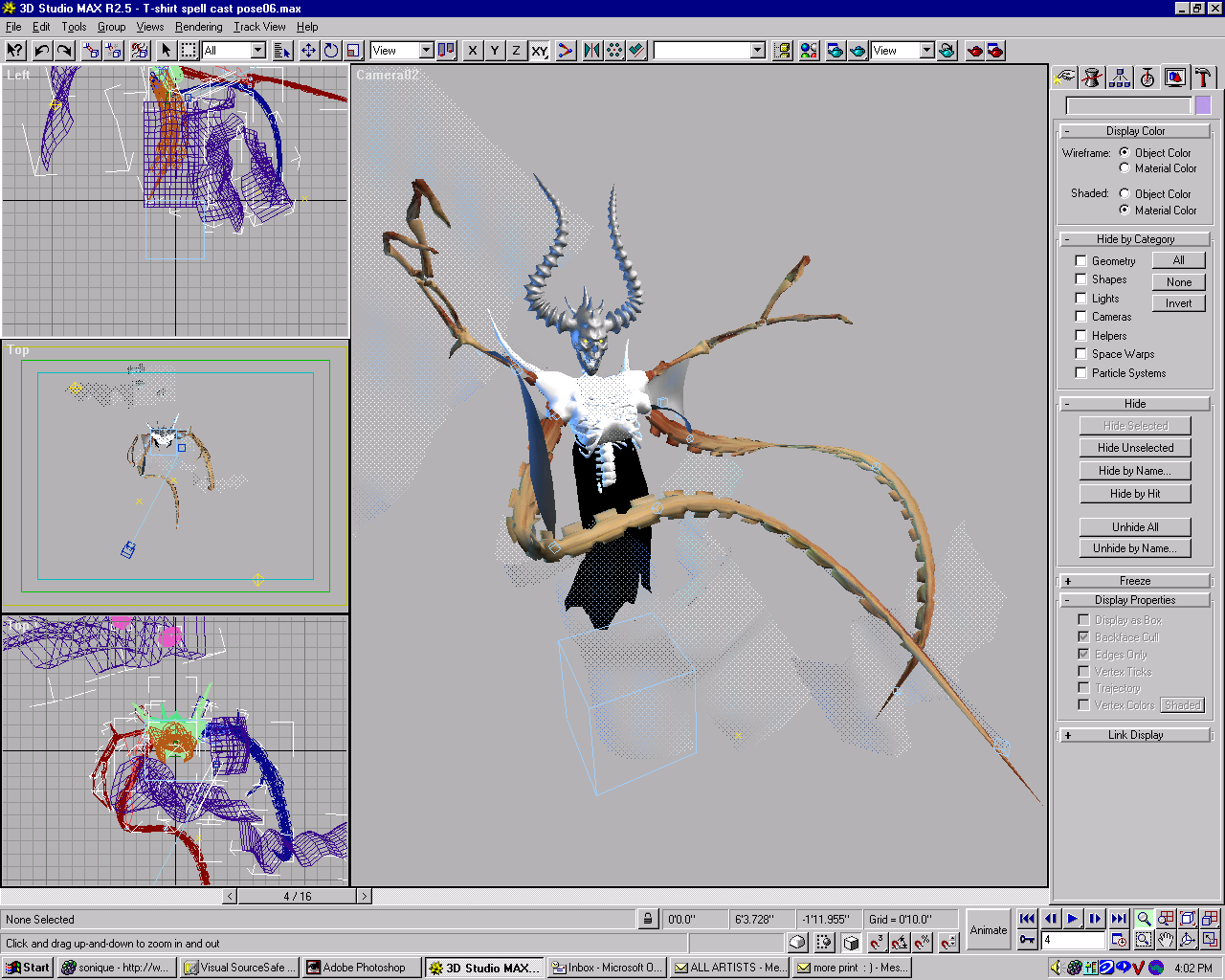
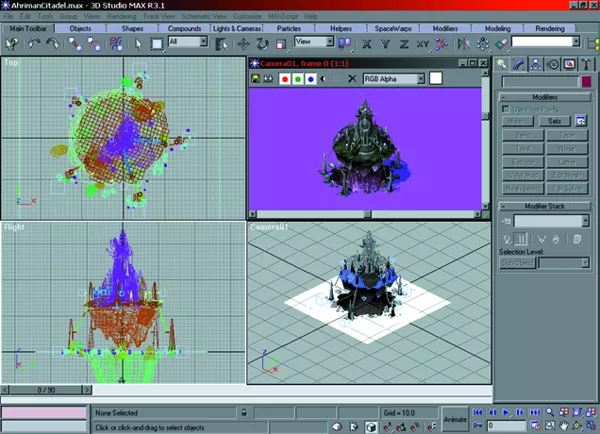
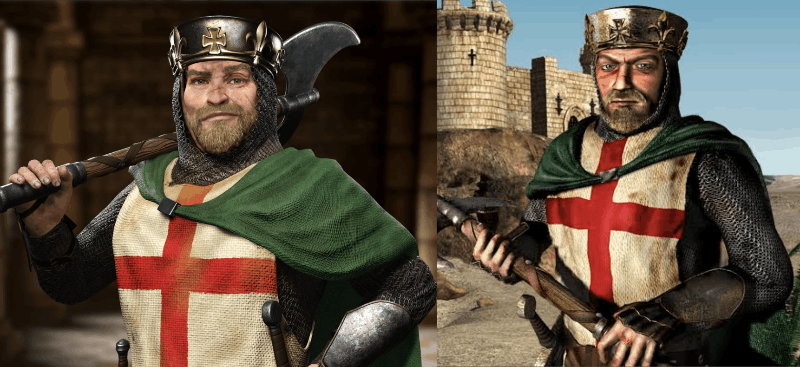
A stellar example of 'overbaking' is what happened to poor Richard the Lionheart in the remastered graphics which look worse (to me). Had they been left alone and spiced up a tiny bit rather than completely reworked for ultra-realism (that somehow ends up looking worse), it wouldn't have been a problem.
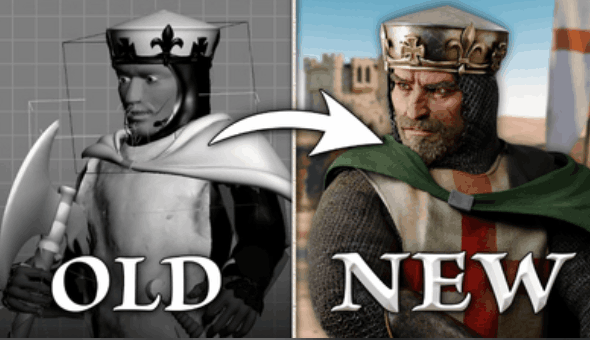
And you can see the original 3D Studio render has a lot more balance (the metallic colours and hair look better with the old renderer too, the new one is not rendered with 3D Studio and you can just tell). While the updated model is more complex and has more realism, that's a complexity improvement not an artistic improvement.
And don't even get me started on the Age of Empires 2 remastered graphics, the newer models somehow manage to have stiffer animation and-- in my opinion -- the new designs look so chunky and not entirely anatomically accurate. Even worse, the cloth animation is noticeably worse-- 3D Studio 4 and MAX never had real cloth physics, so it's shocking to see newer artists not replicate functions that 3D Studio 4 even offered. Let's take the "Teutonic Knight" unit as an example:

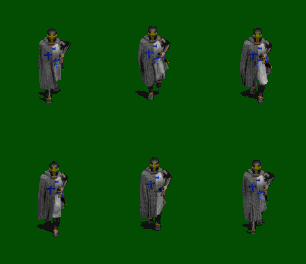
You'll note the new model (left) is worse for animation than the original 3D Studio model (right). Pay attention to how much better the walk bobble is in 3D Studio along with the how the cloth actually looks like cloth and isn't stiff, the covered arm brushes the cloth surface and it moves with it. Ensemble Studios created this technique in 3D Studio 4 and only carried it into MAX with AOE2. While the new model is technically more complex in terms of polygons, it's not well made and our friend walks like he's constipated.
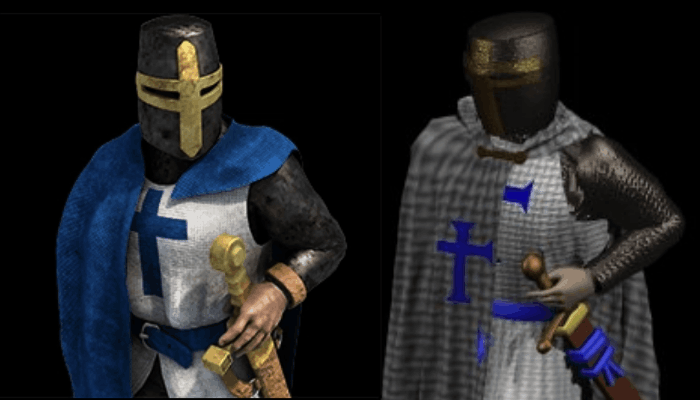
Comparing the two models close up and you'll see the new model has a cape that doesn't attach (just some flat geometry floating above), the hand is too large for proper human ratios, and pretty much everything is noticeably worse despite being a newer more "advanced" model. I would also hasten to such such extreme complexity doesn't matter once the camera is zoomed farther away, so the old model ends up looking visually more advanced at a farther distance.
Overbaking Art and Design
Orson Welles famously said:
The enemy of art is the absence of limitations
I came to this conclusion independently before I stumbled across Orson's quote, to which when he put it in those words, it all made sense. Upon forcing restrictions upon myself in various artistic means... whether that's using a limited palette for graphics or using one synthesizer and nothing else... it fundamentally guided me to come up with solutions and designs that I otherwise would not have if there were no restrictions. Why bother coming up with different solutions and solve difficult problems when you don't have to? You won't.
This leads us to exactly the phenomenon I've been observing as you have a push to more and more and more and more realism. The 3D models start to lose their charm and become "overbaked". Too much detail (or what is perceived as detail) is added and re-added to the point where the visual charm is lost. Colour saturation is gone, hue shifting is gone, and reworking the models and graphics to the point of blandness, losing identifying qualities. Very akin to how music in a lot of games is the most generic orchestral score you ever heard, so too, the visuals are the most generic hyper-realistic ones you ever saw.
Good and memorable design is often centred around harnessing the basics before you start loading on complexities, Paul Rand mentioned that when designing the "abc" logo, while it's simple and everyone thinks they can design it once they see it, they're only saying that because they've already seen the solved design problem. To actually come up with original simple designs without external influence, requires an immense degree of problem solving. It's no different when developing an original memorable character. There's also a time and place for everything... video games are often not simulating realism, and therefore the artistic style complement a video game with an original aesthetic. A few that come to mind:
- Words of Billy/Drilling Billy: the 3D Studio models are complemented with black outlines (I don't know if Bo Nørgaard suggested that or if it was Piet N. Kargaard)
- Westwood NoX: Phill Robb turned off the antialiasing to the final renders giving them a very distinct 'shimmery' look, with very sharp pixel edges.
- Rollercoaster Tycoon: Simon Foster developed a very specific 256 colour palette to use with the 'cartoony' 3D Studio MAX pre-renders, as well as configuring them so that the pixels remain sharp, even for the very tiny guests (you'll note that they will always have at least one black pixel for either eye present)
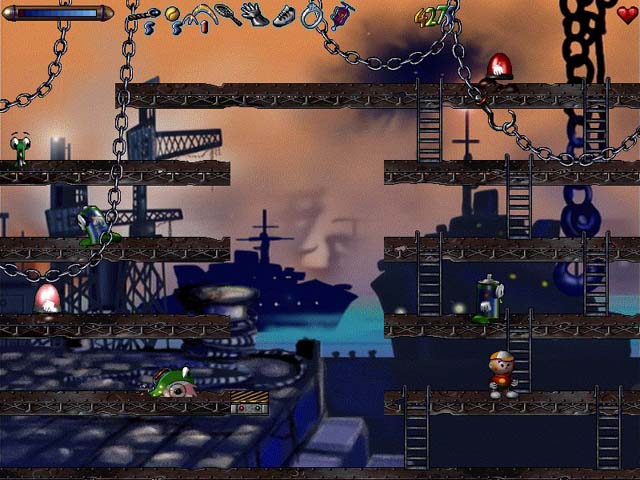
All of the characters have a 1px black outline, harder to see in the compressed JPG though
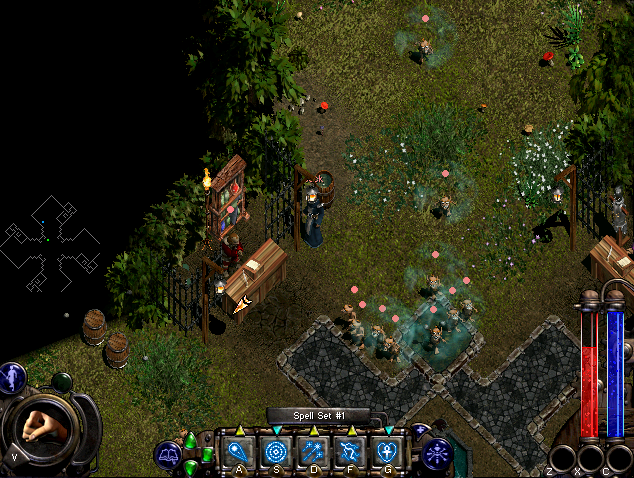
You can see how the renderer makes a lot of the pixel edges very sharp (like on the barrels) due to the lack of anti-aliasing
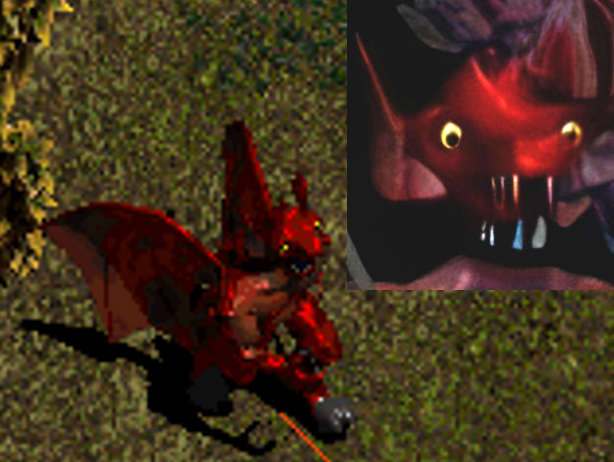
And here's a closeup of the demon lord in NoX alongside with one of the beta character pre-renders. You'll notice just how much heavy lifting the renderer is doing to completely transform how cartoony it looks into a formidable character in-game. And once again, pay attention to the fact that a single (stable) yellow pixel was retained for the eyes-- modern renderers appear to have dropped this important feature. There's also some palette reduction happening, giving some elements a more pleasing contrast than if all textures had the full colour applied.
Meanwhile new games like "Car Park Capital" which don't use 3D Studio (I'm guessing probably Blender?) can't keep 'eye pixels' stable. In this screenshot below the eyes for the people change anywhere from one pixel to four, sometimes horizontal, sometimes vertical... leaving a very unpleasant look the all of the models, this never happens in any 3D Studio rendered games:

I'm also not a fan of how there's not enough colour transition, giving it a very washed out look.
Videos
3D Studio Resources
The DOS 3D Studio could be used with the other following Autodesk products (of importance would be Animator Pro which contained important 'deprecated' features such as palette cycling, I believe the original author released the source code now:
- Animator Pro®
- Texture Universe™
- 3D Studio Plug-In Toolkit
- Cyberspace Developer Kit
- AutoVision™
- AutoCAD®
And in terms of using early 3D Studio 4 and MAX, a few of the more important plugins would be:
- Character Studio (later integrated in 3D Studio MAX with the acquisition of Kinetix)
- Bioflesh (later Bones Pro)
- S-Ray
- Sculpt Animate
There was also the "Autodesk World-Creating Toolkit (for 3D Studio Release 3)", which contained a lot of extra textures and resources.
Some of the magazines / books on 3D Studio I found:
- Inside 3D Studio Release 4, (Master strategies and techniques for maximizing 3D Studio!), New Riders Publishing (ISBN-13: 9781562054151)
- 3D Studio Tips & Tricks Series: Technical Tips for Release 3 and 4, Michele Bousquet (ISBN-13: 978-0827370135)
- 3D Studio 4 Beginniners, New Riders Publishing
Deprecated Techniques
As older 3D Studio pre-rendered style graphics gain interest again, hopefully modern tools can re-implement all of the important features that were once required: specifying fixed palettes, palette cycling, stable fine detail on small pre-rendered models, etc. I haven't seen it yet though... and Autodesk is probably never interested in selling the most important versions of 3D Studio anymore. Oh well.
It's funny how all of the limitations of early computer graphics ended up producing more pleasing results, even if sometimes unintentional.